Investment · FAQ

How does property depreciation work for tax savings in Germany?

DanielDaniel · Financemate Co-Founder
·
January 11, 2025
·
10 min read
Back to FAQ
How does property depreciation work for tax savings in Germany?

Property depreciation is one of the most powerful tax advantages for real estate investors in Germany, allowing you to write off building costs over time while potentially benefiting from property appreciation and tax-free sales after 10 years.

Quick Answer

German property investors can depreciate building values (not land) at different rates: 2% annually for pre-2023 buildings, 3% linear or 5% degressive for post-2023 buildings, plus potential additional 5% accelerated depreciation for energy-efficient properties meeting specific criteria.

Video Tutorial

What is Property Depreciation?

Property depreciation in Germany allows you to account for the natural deterioration of buildings over time. The concept recognizes that buildings have a finite lifespan (typically around 50 years) and components like roofs, heating systems, and structural elements gradually lose value.

Key Principle: Building vs. Land Value

Critical distinction: Only the building value depreciates for tax purposes, not the land value. Land typically doesn't deteriorate over time from an accounting perspective, so depreciation applies solely to the constructed improvements.

Example:

  • Property purchase price: €500,000
  • Land value: €200,000
  • Building value: €300,000
  • Only the €300,000 building value is eligible for depreciation

Depreciation Rates by Building Age

Buildings Constructed Before 2023

Linear Depreciation: 2% annually

  • Slower write-off rate for older buildings
  • Consistent annual deduction over 50 years
  • Simple calculation: Building value × 2% = annual depreciation

Example:

  • Building value: €300,000
  • Annual depreciation: €300,000 × 2% = €6,000
  • Total depreciation period: 50 years

Buildings Constructed After 2023

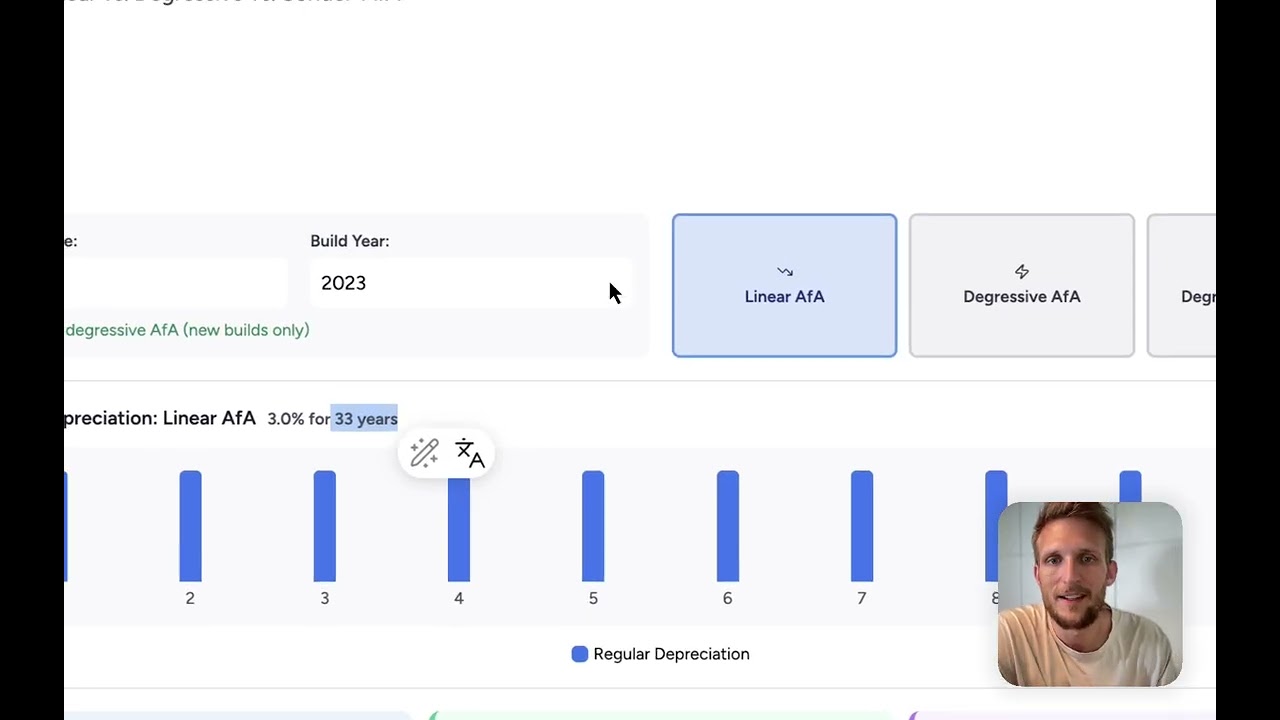
Enhanced Linear Option: 3% annually over 33 years

  • Faster write-off than pre-2023 buildings
  • Higher annual tax deduction
  • Shorter depreciation period

Example:

  • Building value: €300,000
  • Annual depreciation: €300,000 × 3% = €9,000
  • Total depreciation period: 33 years

Advanced Depreciation: Degressive Option (Post-2023 Buildings)

For buildings completed after 2023, investors can choose degressive (declining balance) depreciation instead of linear.

How Degressive Depreciation Works

Initial Rate: 5% of remaining building value Duration: Typically 6 years, then switch to linear Strategy: Front-loads tax benefits for immediate cash flow improvement

Degressive Depreciation Timeline

Years 1-6: 5% declining balance method

  • Year 1: €300,000 × 5% = €15,000
  • Year 2: €285,000 × 5% = €14,250
  • Year 3: €270,750 × 5% = €13,538
  • And so on...

After Year 6: Switch to linear 3% method

  • Once degressive rate falls below 3%, switch to linear
  • Continue with 3% of original building value
  • Maximizes total depreciation benefit

When to Switch from Degressive to Linear

The optimal switch point occurs when the linear rate (3%) exceeds the current degressive rate. This typically happens around year 6-7, ensuring maximum tax benefit throughout the depreciation period.

Additional Accelerated Depreciation

Special 5% Additional Depreciation

For qualifying buildings, investors can claim an additional 5% depreciation on top of the standard rates.

Eligibility Requirements

Energy Efficiency Standards:

  • Buildings must meet specific energy performance criteria
  • Modern insulation and heating systems
  • Environmental sustainability certifications

Price per Square Meter Limits:

  • Maximum purchase price thresholds apply
  • Varies by location and property type
  • Prevents abuse on luxury properties

How Additional Depreciation Works

Rate: Additional 5% (not degressive) Duration: First 4 years only Stacking: Combines with regular depreciation methods

Example with Additional Depreciation:

  • Building value: €300,000
  • Year 1: Regular 5% (€15,000) + Additional 5% (€15,000) = €30,000 total
  • Year 2: Regular 5% (€14,250) + Additional 5% (€15,000) = €29,250 total
  • Years 3-4: Continue combining both rates
  • Year 5+: Only regular depreciation applies

Practical Investment Examples

Scenario 1: Pre-2023 Building

  • Purchase price: €400,000 (€120,000 land, €280,000 building)
  • Annual depreciation: €280,000 × 2% = €5,600
  • Tax savings (assuming 30% tax rate): €5,600 × 30% = €1,680 annually

Scenario 2: Post-2023 Building with Degressive

  • Purchase price: €400,000 (€120,000 land, €280,000 building)
  • Year 1 depreciation: €280,000 × 5% = €14,000
  • Tax savings (assuming 30% tax rate): €14,000 × 30% = €4,200 annually

Scenario 3: Energy-Efficient Building with Additional Depreciation

  • Purchase price: €400,000 (€120,000 land, €280,000 building)
  • Year 1 total depreciation: (€280,000 × 5%) + (€280,000 × 5%) = €28,000
  • Tax savings (assuming 30% tax rate): €28,000 × 30% = €8,400 annually

Strategic Benefits for Investors

Immediate Cash Flow Improvement

Depreciation deductions reduce taxable income immediately, improving monthly cash flow even while the property potentially appreciates in value.

Tax-Free Sale After 10 Years

Combined with Germany's 10-year holding period for tax-free property sales, depreciation creates a powerful wealth-building strategy:

  1. Years 1-10: Claim annual depreciation deductions
  2. Year 10+: Sell property tax-free (if held >10 years)
  3. Result: Tax benefits during ownership + tax-free capital gains

Compounding Wealth Effect

The combination of:

  • Annual tax savings from depreciation
  • Property appreciation over time
  • Tax-free sale after 10 years
  • Potential rental income

Creates a compounding wealth-building vehicle for long-term investors.

Key Considerations and Requirements

Documentation Requirements

  • Clear separation of land vs. building values in purchase contract
  • Energy efficiency certificates for additional depreciation
  • Professional property valuation may be required
  • Maintain detailed records for tax authorities

Given the complexity of German tax law and significant financial impact, consult with:

  • German tax advisors (Steuerberater)
  • Real estate investment specialists
  • Property valuation experts

Planning Considerations

  • Cash Flow Impact: Higher early depreciation improves immediate cash flow
  • Long-term Strategy: Consider total investment timeline and exit strategy
  • Property Selection: Energy-efficient properties offer maximum tax benefits
  • Location Factors: Price per square meter limits vary by region

Common Mistakes to Avoid

Incorrect Value Allocation

  • Failing to properly separate land and building values
  • Using outdated or incorrect valuations
  • Not documenting value allocation properly

Missing Additional Depreciation

  • Not verifying energy efficiency qualification
  • Failing to claim available additional 5% depreciation
  • Inadequate documentation of building standards

Poor Timing Decisions

  • Not optimizing degressive vs. linear choice
  • Failing to switch depreciation methods at optimal time
  • Not coordinating with overall tax strategy

Next Steps for Property Investors

  1. Property Analysis: Evaluate potential properties for depreciation benefits
  2. Tax Planning: Integrate depreciation strategy with overall tax planning
  3. Professional Consultation: Engage qualified German tax and real estate advisors
  4. Documentation: Ensure proper record-keeping from purchase onward

Property depreciation represents one of Germany's most valuable tax advantages for real estate investors. Combined with strategic property selection and proper planning, it can significantly enhance investment returns while building long-term wealth.

Disclaimer

⚠️ IMPORTANT LEGAL DISCLAIMER:

This content is for educational and informational purposes only and does not constitute financial, tax, legal, or investment advice. You should not rely on this information as a substitute for, nor does it replace, professional financial or tax advice. Always consult with qualified professionals (tax advisors, financial planners, lawyers) before making any financial decisions or taking any actions based on this information.


Disclaimer: This is general information and may differ for individual cases. Learn more about financial planning with Financemate in a discovery call.

How does property depreciation work for tax savings in Germany? | Financemate FAQ