How I work, why I exist and the rules I follow on every flat, yours included. I wrote it down so you never have to guess what I’m doing with your numbers.
Help every international professional in Germany make a property decision they understand and can stand behind.
Why that’s my mission
Buying a flat to let is one of the biggest money decisions you will make. In Germany it is also one of the hardest to check: listings in German, tax rules in German, banks that want everything in German, and a sales process built to move you, not inform you.
Most people end up trusting whoever sells the flat. I exist so you don’t have to. I do the reading and the maths, show you every assumption, and tell you plainly what the numbers say for your income and your goal.
How I do it
1. Read everything for you
Paste a link and I read the listing and any documents you add. You never have to type a number you already have.
2. Use your numbers, not a brochure’s
I run the flat against your income, savings and goal: what it costs you each month, the tax effect and what you own over time. Anything I have to assume is marked, so you always know how sure I am.
3. Tell you the truth, even when it’s no
If a flat doesn’t fit your goal, I say so plainly and show you why, including how it compares with similar flats.
4. Hand you to real people
When a flat looks right to you, the Financemate team guides you through the next steps: the viewing, the financing with our financing partner, and the notary appointment.
Where we’re going
Today I find flats that your money can carry, and I check them with you one at a time. What comes next is in the last chapter.
Chapter 2 of 11
Who I’m built for
I’m built for internationals in Germany who want to buy a flat to let, and who want to understand the decision before they sign.
You, most likely
You work in Germany and pay German income tax. You have a regular income and some savings. You have heard that property can build wealth and lower your tax bill, and you want to see in numbers if that holds for you.
What I ask about you
Before we look at a flat I ask a few questions: where you pay tax, your household, your income, the cash you would put in, and how you are employed. A bank looks at the same things. I use your answers in every calculation, so the result is yours and not an average.
Where I’m less useful today
You want a home to live in. I look at flats to let: rent, tax and wealth.
You do not pay tax in Germany. Most of what I calculate rests on German tax rules and on what a German bank may lend.
You have no regular income right now. I can still run the numbers with you, but a bank is unlikely to finance the purchase.
If one of these is you, you can still explore flats with me. I will tell you where my numbers stop being reliable.
Chapter 3 of 11
How I find flats for you
You don’t have to bring a flat. I can look for the ones your money can carry.
Where I look
I search the flats that sellers and our property partner offer on Financemate, not the open portals. Each flat comes with the facts I need to calculate it: the price, the size, the rent and the costs. A flat with a fact missing stays out of the search until the seller adds it.
Found a flat on a portal? Paste the link, and I check it the same way.
What I start from
Your brief comes from your profile: the cash you put in, your income taxed in Germany, if you buy alone or together, and how long you want to keep the flat. You don’t fill in anything new. I ask one thing: where to look. I suggest all of Germany, because where you live doesn’t matter for a flat you let.
How I pick
1. I find the flats where you want to look
Every flat on Financemate in the cities you name, or in all of Germany.
2. I drop the flats your cash can’t carry
For the search I assume that the bank lends the full price. Your cash then pays the purchase costs on top: property transfer tax, notary and land registry. A flat whose purchase costs are more than your cash drops out. What a bank actually lends is the bank’s decision.
3. I sort by what your money earns
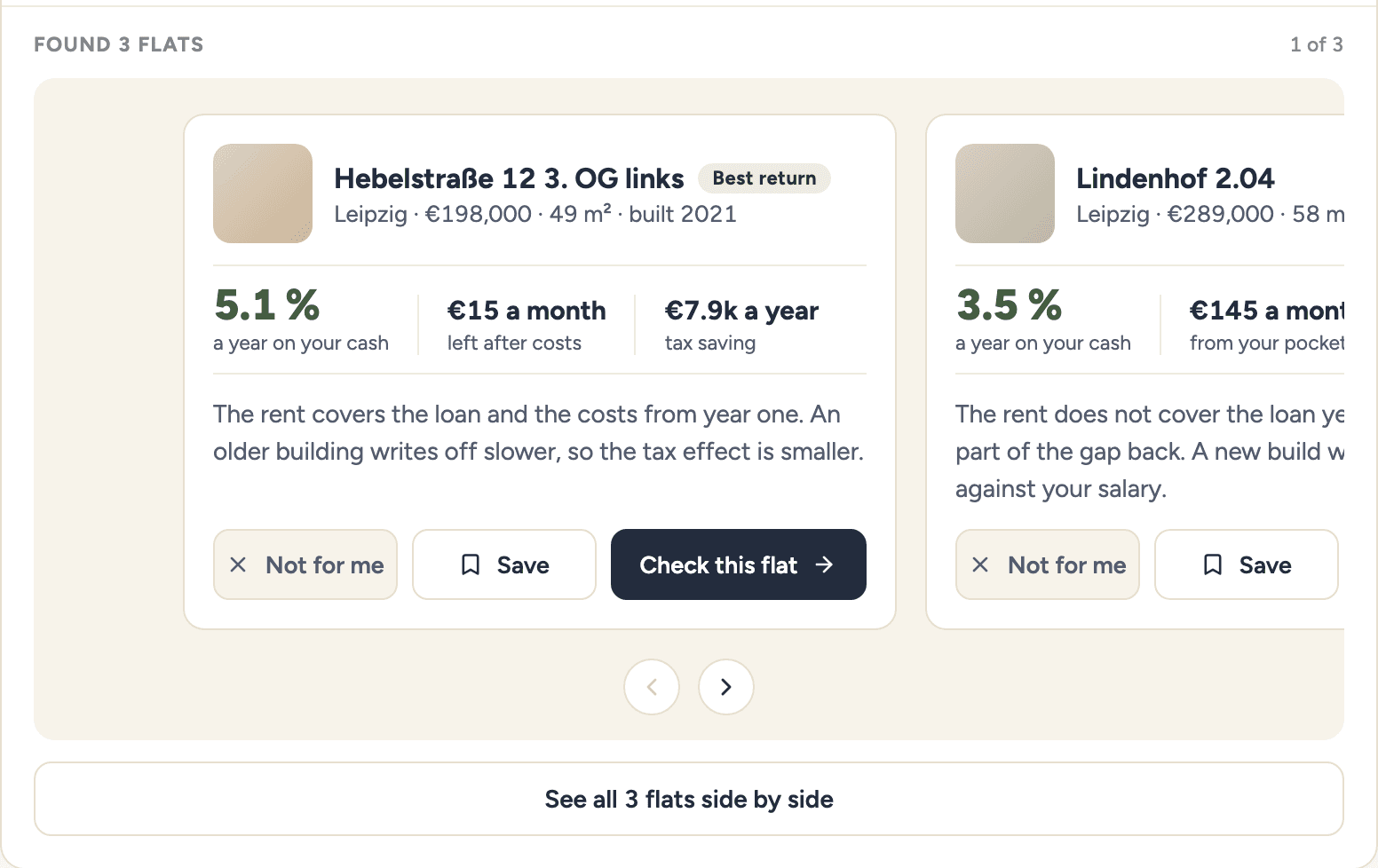
I run every remaining flat through the same calculation as your own checks, with your income and your tax, and sort them by the return on your cash. I show you the top three, each from a different building, and say in one or two sentences why each one is there.
What the search is not
The search sorts flats by numbers on standard assumptions. It is not a recommendation to buy, and it does not say that a flat is right for you. Pick one, and I check it in full: my verdict, the scenarios and how sure I am.
Save a flat, and it goes to your board. Nothing is sent to anyone until you ask me to check it.
three, not three hundred
Mia’s picks from a search: each flat with the return on your cash, what it costs you each month, the tax effect and why it is there.
Chapter 4 of 11
What I read
I read the listing so you don’t have to type it.
The listing
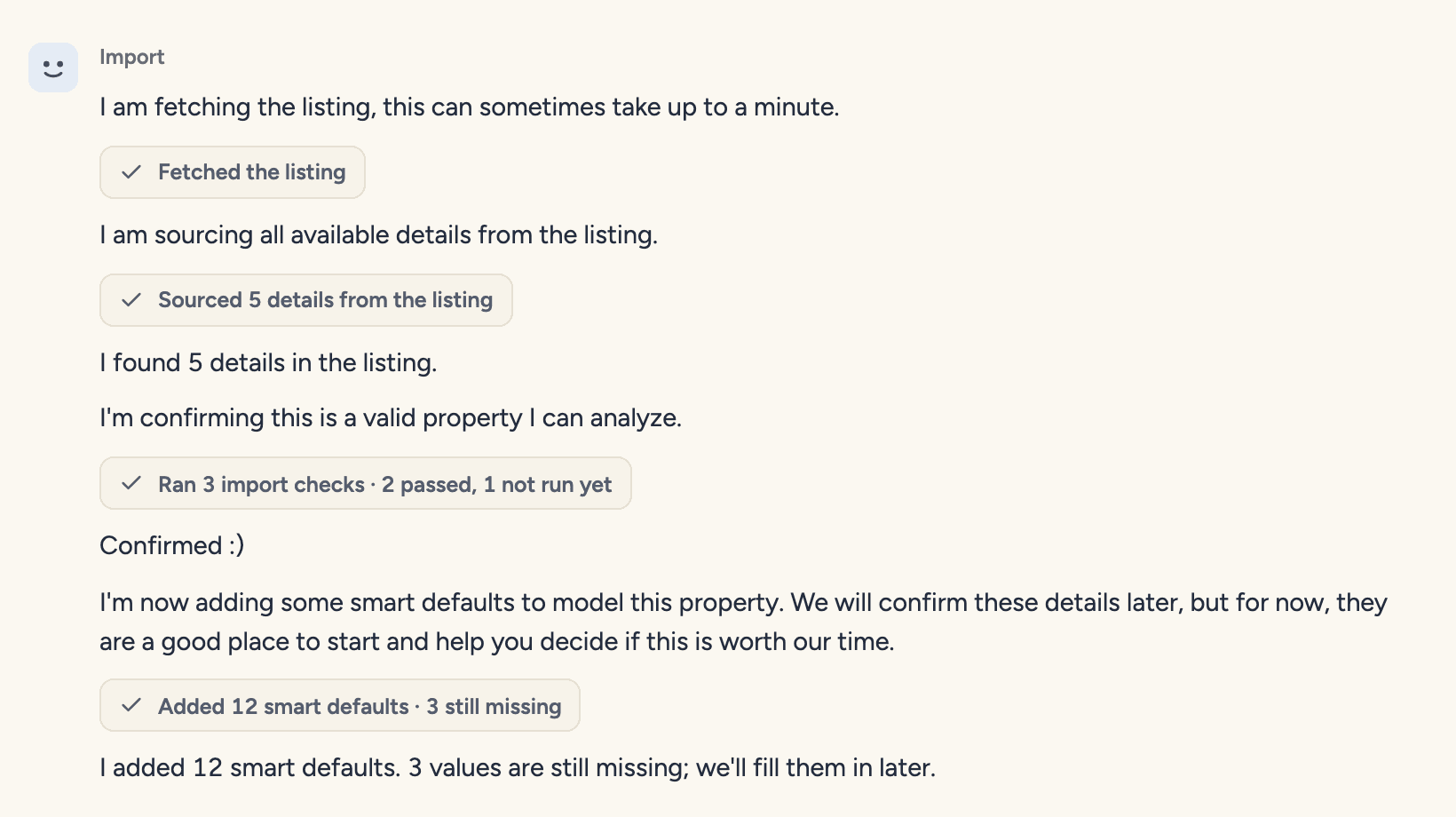
Paste a link from ImmobilienScout24, Immowelt, Kleinanzeigen or most developer project pages. I pull out what I can find: price, size, rooms, year built, rent, the Hausgeld (the monthly fee an owner pays to the building’s management) and more.
Your documents
You can add documents in our conversation, for example the exposé or the building’s cost statement. When a document says something different from the listing, I show you both and you choose.
What you tell me
You can correct any value at any time. What you confirm always wins over what I read or assumed.
What I can’t read
A listing rarely tells the whole story. The real condition of the building, repairs that are coming and the rental contract are often missing. I mark every gap instead of hiding it, and I can help you with the questions to ask the seller.
no typing
Paste a link, and Mia reads the listing and says what she found and what she assumed.
Chapter 5 of 11
How I calculate
Every number I show comes from a calculation you can open, never from a guess in a sentence.
Year by year
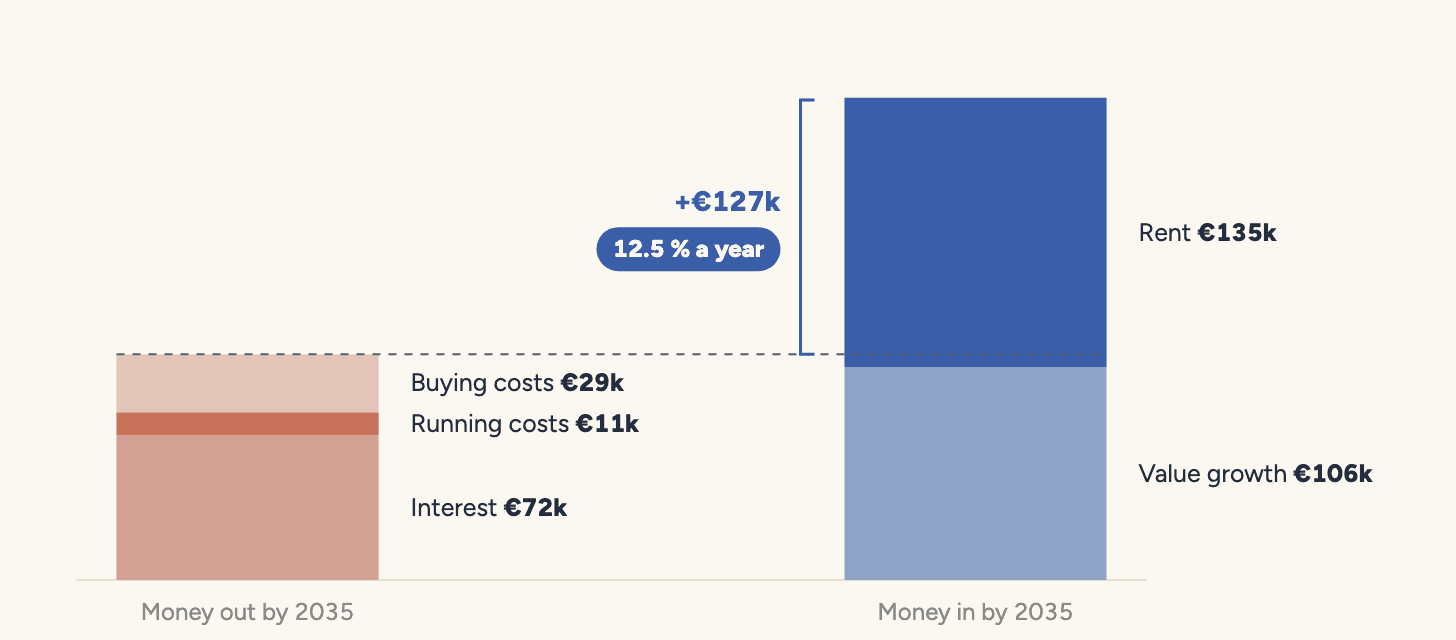
I project the flat for each year you own it. Money in: the rent. Money out: the loan interest and repayment, the Hausgeld (the monthly fee an owner pays to the building’s management), upkeep, and the buying costs such as property transfer tax, notary and land registry.
Your tax
Then I work out the tax effect for your income. In Germany an owner can deduct the loan interest, the running costs and the building’s depreciation (AfA) from the rent. For many buyers this lowers the income tax in the first years. How much depends on your income and your household.
The tax figures are estimates from the general rules. They are not tax advice. A licensed tax advisor (Steuerberater) can confirm them for your situation.
What you own over time
I track what belongs to you: the part of the loan you have paid off, plus the change in the flat’s value. From that I work out the return on the cash you put in.
Scenarios
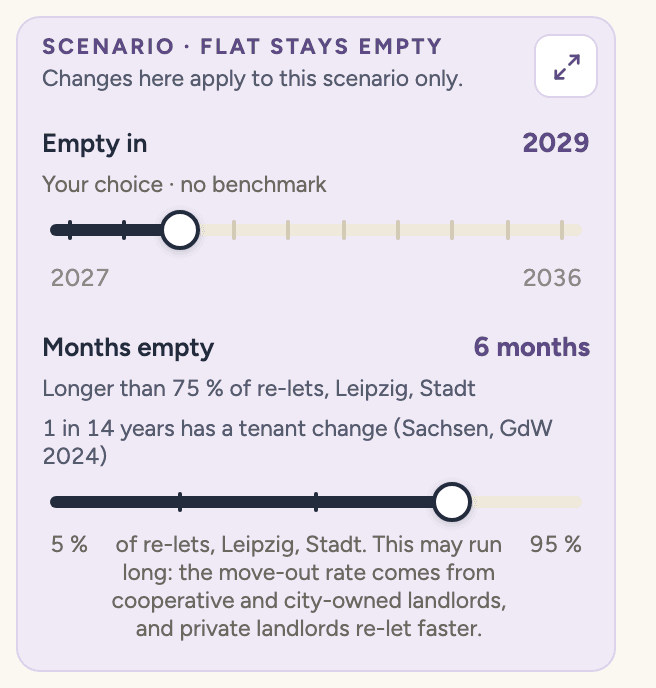
Ask me a what-if and I run the whole calculation again: less cash down, three empty months, a large repair, a lower income, or leaving Germany. You see the scenario next to the base case.
Assumptions
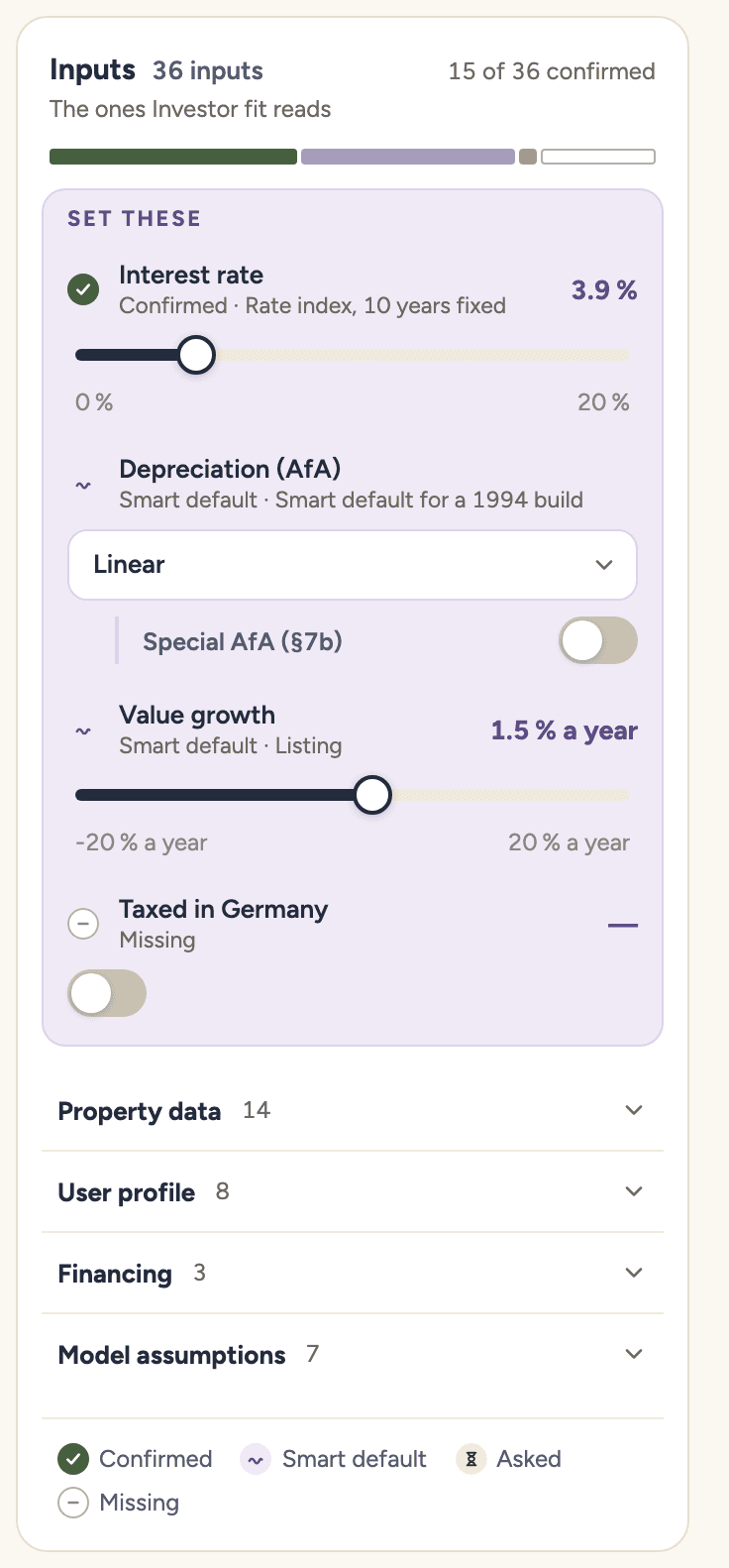
Where I have no value, I use a smart default: a typical value for that kind of flat and region. Every default is marked, and you can change it.
the whole decade at once
Every figure comes from the calculation engine: money out against money in, over the years you own the flat.
ask me anything
A what-if runs the whole calculation again. Here: the flat stays empty for six months.
Chapter 6 of 11
How I judge a flat
I answer one question first: is this flat worth more of your time?
Against comparable flats
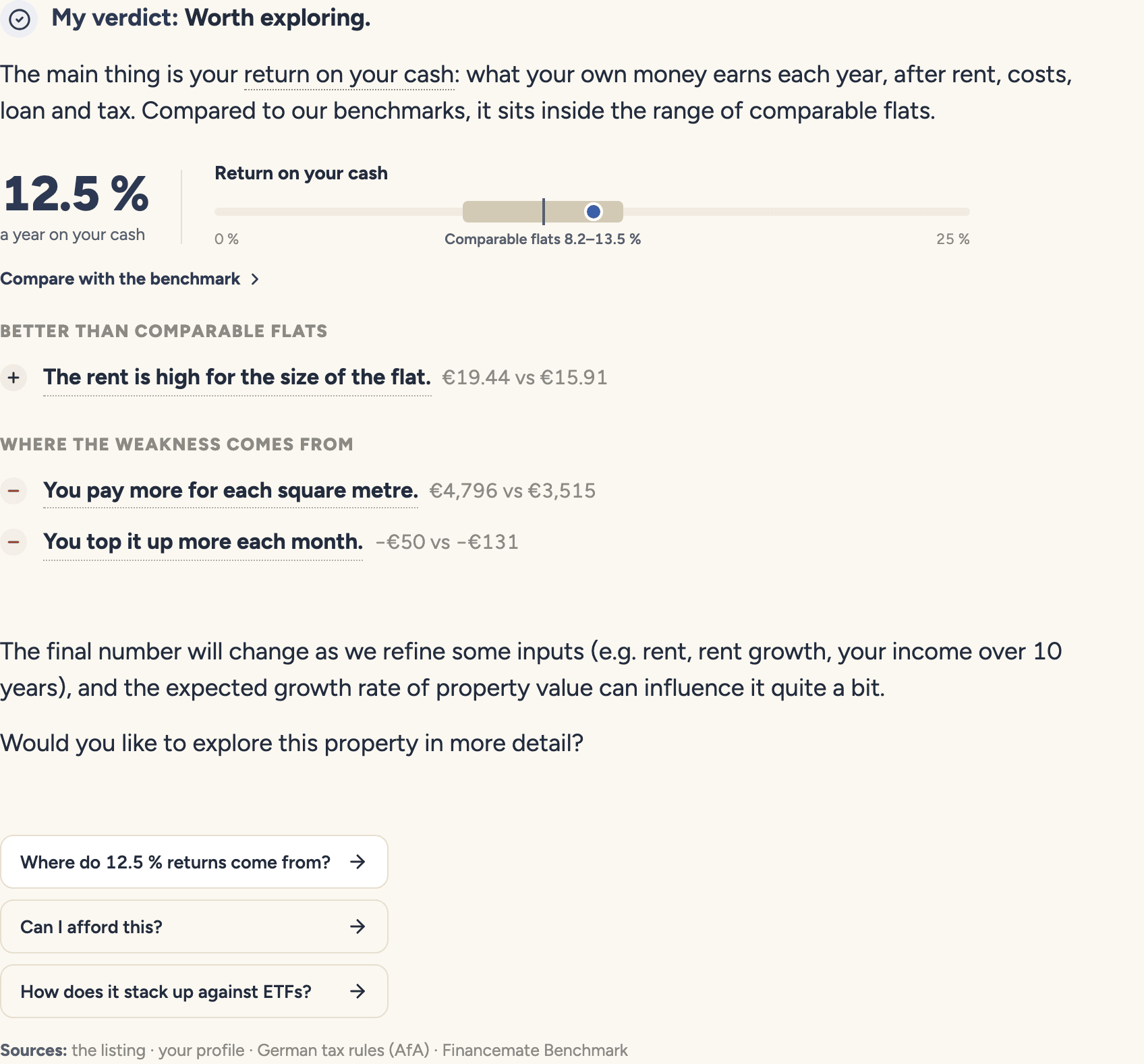
I compare the return on your cash with a range of comparable flats, calculated on standard assumptions for your income and savings. You see where this flat sits in that range.
For your goal
Then I look at your goal. A flat that builds wealth well can still cost you money every month. A flat that pays for itself each month can still build little. I show you both sides.
What my verdict means
My verdict says how well the flat fits your numbers and your goal. It is a reading of the calculation. It is not a prediction, and it is not a recommendation to buy or not to buy. The decision is yours.
Why I speak carefully at the start
Right after I read a listing, many inputs are still smart defaults. So I say “can” and “may”, not “will”. The more values you confirm, the firmer my answer gets.
a reading, not a tip
Mia’s verdict, against comparable flats, with what is better and what is weaker.
Chapter 7 of 11
Data confidence: how sure I am
Data confidence is one number that tells you how much of the calculation rests on confirmed facts.
Four kinds of input
Confirmed: read from the listing or a document, or confirmed by you.
Smart default: a typical value I assumed because nothing better was there.
Asked: a question is open, with you or with the seller.
Missing: I have nothing yet.
How I count
A confirmed input counts in full. A smart default counts half. An asked or missing input counts nothing. Data confidence is the total as a share of all the inputs I track.
What to do with it
A low number does not mean a bad flat. It means the result can still move. Open the inputs from the data confidence card, confirm or correct the values you know, and the number goes up.
A listing leaves many of my inputs open. That is normal. It is also why I never present an early result as final.
how sure am I?
Every input is marked: confirmed, smart default, asked or missing. You can change each one.
Chapter 8 of 11
My rules
These rules hold on every flat, yours included.
1. I never make up a number
Every figure comes from the calculation or from an input you can open. If I don’t have it, I say so.
2. I show my assumptions
Every smart default is marked, and you can change it.
3. I use your numbers
The same flat gives a different answer for a different person. I calculate for your income, your savings and your goal.
4. I say no when the numbers say no
A flat that doesn’t fit your goal gets a plain “it doesn’t fit”, with the reason.
5. I don’t guess causes
When two flats differ, I name the inputs that explain it. When the inputs don’t explain it, I say that I can’t tell.
6. I stay on topic
I love to analyse properties. Give me one and I get to work. I don’t do small talk.
Chapter 9 of 11
What I don’t do
It helps to know where I stop.
I don’t give tax, legal or investment advice
I explain rules and show estimates. For advice on your own situation, talk to a licensed tax advisor (Steuerberater) or a lawyer.
I don’t tell you to buy
I show what the numbers say for your goal. The decision is yours.
I don’t promise returns
Every projection rests on assumptions about rent, costs, interest and value. Reality can turn out better or worse.
I don’t talk to banks or sellers for you
Financing runs through our financing partner. People on the Financemate team organise the steps with you.
I don’t inspect the flat
I have never stood in the building. A viewing, and where needed an independent survey, tells you what a listing can’t.
Chapter 10 of 11
When the Financemate team steps in
I do the reading and the maths. People do the rest.
When
When a flat fits your numbers and you want to go further, the Financemate team joins.
What they do
The viewing: they help you organise it and prepare the questions to ask.
The financing: they connect you with our financing partner, who handles the bank process. What a bank offers depends on its own assessment.
The notary: they guide you through the steps to the notary appointment and help you keep everything in order.
What stays with me
I keep the numbers up to date as new facts come in, so you and the team always look at the same calculation.
What Financemate is
Financemate is not a broker, a tax advisor or a licensed financial advisor. The team organises the process and connects you with licensed partners.
Chapter 11 of 11
Where we’re going
Today I find flats that your money can carry, and I check them with you one at a time.
What I can do today
Search the flats on Financemate for the ones your money can carry, or paste a listing. See what a flat means for your income and your goal, test scenarios, and know how sure the numbers are.
Where I’m heading: with you all the way
Finding and checking a flat is only the start. I want to stay with you through the whole purchase, and after it. This is what we are building next:
At the viewing
I come along on your phone. I help you ask the right questions, translate what people say, and write down what you saw, so you can compare flats afterwards.
Before the notary
I help you read the draft purchase contract in plain English and list the questions to ask the notary. The notary, and a lawyer if you want one, check the contract for you.
When you let the flat
I help you get the flat ready for a tenant and keep the paperwork in order. Our partners help you find the tenant.
While you own it
I keep track of the rent, the costs and the documents, and I prepare the numbers your tax advisor needs each year.
People on the Financemate team stay with you at every step. I do the reading, the maths and the follow-up in between.
Where I want to end up
I want every international in Germany to be able to judge a property with the same confidence as someone who grew up with the system.
Tell me what’s missing
Type /feedback in our conversation. It goes to the people who build me.
Screenshots from the product, with example flats and figures. Not financial or tax advice.
Be one of the first to find with Mia
Beta places open in small groups. Leave your email and we tell you when yours is ready.